Sunday, November 24, 2013

Happy Thankgiving!

As most of you know I am a fall color freak. So when we were landing in Chicago upon our return from vacation the oranges, yellows and reds made me long for the hardwoods of my Midwest childhood. Well until the 32 degree 'Windy City' greeted us as we waited for my sister to pick us up. Then I remembered what had driven me to move to Tucson in 1976. When we returned home we were assuming that the autumnal hues would have peaked long ago but were delighted by the electric yellow of the Cottonweeds (not a misprint) as we drove through Silver City. And we could see the bright red of our Bradford Pear from Highway 90. Today we are enjoying the first of (I hope) many winter snows and fall color is a distant memory. If it does turn warm and dry this is your friendly reminder to water this winter. If there has not been any significant precipitation for 3 weeks use that moisture-meter of a finger and dig down a couple of inches around your plants. If it comes up dry, water thoroughly to keep those growing roots hydrated.

Thanksgiving is just around the corner and Steve and I both hope you take time to enjoy this day any way you choose to do so! Don't forget SMALL BUSINESS SATURDAY on the 30th. We are lucky to have so many great small merchants here. Please get out and support them!


In December the Evergreen Garden Club is hosting their Enchanted Christmas Tree Tour. Susan & Fidel Hinojosa have been kind enough to open their historic home at 615 A Street in Silver City for this event. 

Saturday, December 7th                    Sunday, December 8th
4:00 PM - 8:00 PM                              3:00 PM - 7:00 PM

Saturday, December 14th                   Sunday, December 15th
4:00 PM - 8:00 PM                               3:00 PM - 7:00 PM

There will be 25 Decorated Trees and a Miniature Christmas Village.
Tickets are only $5.00 for adults and $1.00 for children 12 and under. They are available at Alotta Gelato, AM Bank, Aunt Judy's Attic and at the door. 

Proceeds benefit Children's Charities in Grant County.


This is really a wonderful Holiday experience! Hope to see you there.


Friday, September 27, 2013

End of The Season

COME TO OUR END OF THE SEASON SALE!
  • Beginning Saturday, September 28th at 9:00 all trees, shrubs, perennials and annuals will be 50% OFF!
  • We are also offering Fox Farm Light Warrior Seed Starting Mix at $5.00 a bag (regular price $16.75)!
  • All of Jan's Garden Art & Windchimes are 10% off!
Come early for the best selection.
We will be closing for the season on Saturday, October 5th.

THINGS TO DO:
Apply dormant sprays. This will be a job for the winter months but I wanted to remind you so you could pick these items up before we close for the season. If you have had problems with scale, spider mite, whitefly or mealy bug on your fruit or shade trees and ornamental shrubs you may want to treat these landscape plants with All Seasons Horticultural & Dormant Spray Oil. This product can be used during the growing season but is also effective when used in winter to smother the eggs of these pests. Spray Oil can also safely be applied to many houseplants. Lime Sulfur Spray can be used in fall as the leaves drop and again in early spring to help control powdery mildew and several kinds of scale. It can be mixed with Spray Oil at a rate of 4 oz. Sulfur and 1 1/4 oz. Spray Oil per gallon of water and sprayed when winter buds swell before opening to kill insect eggs and fungus spores. Liqui-Cop is a copper fungicide that is effective against shot hole fungus, fireblight, black spot, bacterial leaf spot, peach leaf curl and many other fungal diseases on fruits and berries. Be sure to follow label directions carefully as application timing and quantities vary by the plant being treated and the insect or disease being controlled. Rake up and destroy any leaves of  affected plants and spray the ground surrounding them.


PLANT OF THE MONTH:
Ligustrum x vicaryi. The Golden Vicary Privet is a low maintenance shrub that will grow quickly to 4-6' tall and wide. It tolerates full sun or part shade. New leaves are glossy yellow maturing to dark green. Commonly used as a hedge or screen this privet could also be planted in the back of a perennial bed where the golden color would contrast nicely with red and blue flowers. It is cold hardy to minus 20 degrees and a low water user once established.

Ligustrum x vicaryi

We really appreciate your continued support and will see you in the spring. Enjoy the winter!

Wednesday, September 11, 2013

Reminders

Our final truck of the year delivered some beautiful Pansies, Violas, Mums, Dianthus, Snaps and Fall Veggies just in time for this lovely autumnal weather. We also received a few Russian Sage (Perovskia atriplicafolia), Autumn Sage (Salvia greggii) and Rosemary (Rosmarinus) both trailing and upright.

Don't forget that we will open either March 25th or April 1st next year so if you need any gardening supplies before that you might want to pick them up now. We have Uni-Gro Potting Soil, Back to Earth Compost, Wall-o-Water, Fox Farm Fertilizer, Floating Row Cover, Rooting Hormone, Etc.

See you soon!

Wednesday, September 4, 2013

September 2013

 First, I apologize for being tardy on my posting. No computer, then a new computer and friends in from out of town have put me behind schedule. So here goes.

THINGS TO DO:
Control mosquitos. With all of this glorious rain come mosquitos. There are several ways you can diminish the impact they have on your outdoor life. Wear light colored clothing and try to stay indoors at dawn and dusk when the little devils seem to be most active. If you use an insect repellant try a product containing geraniol instead of toxic DEET. You can buy this as a wristband, diffuser or spray. Of course you will want to find any places that collect water and make sure they are emptied, turned over or provided with drainage. We carry Summit Mosquito Dunks that are a non-toxic biological control for specific insect larvae including mosquitos and black flies. The dunks will not harm birds, pets or fish so they can safely be used in birdbaths and ponds. It will kill the larvae before it becomes a blood sucker. The Mosquito Dunk also comes as Mosquito Bits. Same active ingredient but easier to sprinkle around and it also works on fungus gnats. Those nasty little fly-like creatures that find refuge in moist potting soil and fly up your nose when your sitting there watching TV, on the computer or reading a book. So try any or all of these precautions and enjoy this gorgeous weather!

Plant pansies and violas. I don't know about you but some of my pots are looking very tired. Next week we will have in our final load of pansies, violas, snapdragons, mums, dianthus and a large selection of fall veggies. Pansies and violas love cool weather and will grow all winter long in our area. Snapdragons and dianthus are basically perennial here and will bloom very early in the spring if planted now. Cool season vegetables that will still produce well are spinach, lettuces, beets, carrots, radishes, broccoli, cabbage and more. Look for our sign out on 180 and we'll let you know when they are here.

Apply a winterizer fertilizer. Here is a copy of last years post: You will want to use Gro-Power 3-12-12. This fertilizer is low in nitrogen but high in phosphorus and potash. Nitrogen promotes green growth which can be damaged by freezing temperatures. Phosphorus increases winter hardiness and stimulates healthy root growth. Since this is the time of year that plants naturally do the majority of their root growth, using this fertilizer will get them off to a good start next spring. Potash or potassium produces strong, hardy stems and trunks, promotes disease resistance and also increases winter hardiness. The Gro-Power 3-12 12 contains 7% humic acid which encourages beneficial microorganisms in your soil. It also includes sulphur to help bring the alkalinity of our soil down and several micronutrients that act as catalysts for the primary chemicals. Use this fertilizer at a rate of 2 pounds per 100 square feet of lawn or bed area and 2 tablespoons per foot of height or width for trees and shrubs. One cup will fertilize an 8 foot tree. Lightly work the fertilizer into the soil around the root area and water thoroughly.

PLANT OF THE MONTH:
Cerastium tomentosum. Snow-in-Summer is a tough groundcover that grows rapidly to 6-8" tall by 1-2' in one season. The short silvery-gray leaves form a dense mat and the small white flowers bloom profusely in early summer. It is native to Italy but adapts well to our climate and is at home in a rock garden, spilling over a wall, as a bank cover or in the front of a perennial bed. I especially like it combined with Verbena 'Homestead Purple'. This perennial is drought tolerant, hardy to 30 degrees below zero (zone 4)  and can grow in full sun or half a day of shade.

Snow-in-Summer

'Homestead Purple' Verbena with Snow-in-Summer


Sunday, July 28, 2013

August 2013 & Sale

THINGS TO DO:
Come to our August Sale! We are having a big sale beginning Tuesday, July 30th and running through August, while supplies last. All of our Weeks & Proven Winners Roses as well as our evergreen, flowering, fruit and shade trees are 20% OFF!!! There is still a good selection so come early and often.


 We also have our Lake Valley & Pagano Seeds on half price through August 10th. Stock up for fall planting this year or spring next year.

Divide Iris. After 3 or 4 years Iris will become overcrowded and their blooms will diminish in size and quantity. This is a good time to breathe new life into them by dividing the bulbs. Dig the clumps and separate them saving the largest rhizomes with healthy leaves and cutting away old leafless portions. Trim the saved bulbs to 6" of leaves above the rhizome and 6 inches of roots below. Let them dry over night before replanting in soil that has been amended with Back to Earth Compost Blend and a source of phosphorus such as  Bone Meal, Bulb Food or Soft Rock Phosphate. Plant 1 to 2 feet apart with the soil coming to the top of the bulb. Water thoroughly and you will be amazed at how much better your iris perform next year.

Control Snails. With all of this rain we have been getting (Yaaaaaay!) the snails are returning in droves. They hide out under garden debris and other shady areas during the heat of the day and come out to dine on your plants when it's cool. They have toothlike jaws that eat holes in your plants' leaves and flowers. To control them start by clearing out their hiding areas. You can fill shallow containers with beer or a little yeast and sugar mixed with water and this will lure the little lushes in to drown. Happy, but dead. There is also an organic product called Sluggo. This product, which we sell, is simply iron phosphate with a bait additive. It is very effective and after eating the bait, slugs and snails will stop feeding, become less mobile and begin to die within three to six days. It is OMRI (Organic Materials Review Institute) registered and can be applied at a rate of 1 lb per 1000 square feet or 1 teaspoon per square yard. It is safe to use around pets, wildlife and homo sapiens.There is also a Sluggo Plus that is iron phosphate with Spinosad added and it controls sow bugs (aka pill bugs or rollie pollies) as well as snails and slugs. It is also organic and eco-friendly.

PLANT OF THE MONTH:
Caryopteris x clandonensis. Blue Mist or Bluebeard is a deciduous shrub that will grow from 3-4' tall and wide. The variety we carry is 'Dark Knight' and it blooms from July through September with deep blue flowers that attract butterflies and bees. The flowers appear in clusters on the top part of the stems and the leaves are gray-green. It would work well in a perennial bed, along a walkway or as a foundation plant. To keep it full you should cut it back to a foot tall in the spring. This shrub will sometimes reseed but is not invasive. We also grew a dwarf variety of the species this year called 'Petit Bleu'. It is a Proven Winner and has a more compact growth habit, only reaches 2' tall and wide and its foliage is darker green. All of the Bluebeards are drought tolerant once established, will grow in full sun or part shade and are cold hardy to zone 5 or 20 degrees below zero.
Caryopteris x clandonensis 'Petit Bleu'

Friday, July 12, 2013

Free Veggies!

We have a few vegetables left and they are free for the taking Friday, July 12th and tomorrow Saturday, July 13th. While supplies last!

Monday, July 1, 2013

July 2013

THINGS TO DO:
Start a Butterfly Garden. Butterflies are beautiful creatures. The adults are good pollinators and the larvae of some called Harvesters eat harmful insects. It is actually quite easy to attract butterflies to your garden. Butterflies like to sun themselves and will only drink from very shallow water. Flat rocks with indentations that collect or can be filled daily with water, or a container full of sand that has been saturated with water are good places for butterflies to get a drink. You will want to plant perennials, annuals, shrubs and trees that serve as a nectar source for adults as well as supplying suitable plants for their caterpillars. When laying their eggs butterflies seek out host plants that the larvae will use as their food. Most of the time the caterpillars will not destroy a plant but only eat for a while, pupate and be gone. Trees that act as host plants include Malus (Flowering Crabapple), Platunus (Sycamore) and Prunus (Plum). Munchable shrubs are Hibiscus, Rosa (Rose), Spiraea, Viburnum (Snowball) and Wisteria. Annuals and Perennials would be Achillea (Yarrow), Alcea (Hollyhock), Brassicas (Broccoli, Cabbage and Mustard), Lobularia (Alyssum), Penstemon and herbs such as Fennel, Dill and Lovage. Nectar producers for adults include the flowers of Apples, Vitex (Chaste Tree), Lavandula (Lavender), Lonicera (Honeysuckle), Syringa (Lilac), of course Buddleia (Butterfly Bush), Rosmarinus (Rosemary), Centranthus (Jupiter's Beard), Echinacea (Coneflowers), Achillea (Yarrow) and Rudbeckia (Black-eyed Susan). These are a few of the plants that butterflies enjoy. For a complete list stop by the nursery. Butterflies are fun and relaxing to watch so start your butterfly garden today.
.
Plant something. We are hoping that the monsoon is right around the corner for a multitude of reasons and since plants do 80% of their root growth in late summer, fall and winter now through early fall is really the best time to plant. Some rain and humidity will make watering a little less critical. Choose a tree, shrub or perennial and dig the hole twice as wide and 1 1/2 times as deep as the container. Add 1/3 Back to Earth Compost Blend to 2/3 of your native soil (I know it's bad) mix it up and use this mixture to plant. If your soil is clayey add Gypsum. Use B1 as a root stimulator when watering your new plants. The best way to check to see if any plant needs water is to stick your finger in the soil and if it dry 1'' down water thoroughly. Do a rain dance, plant something and be rewarded next spring.

ALL OF OUR VEGETABLES ARE "BUY ONE GET ONE FREE" 
WHILE SUPPLIES LAST!!!

PLANT OF THE MONTH:
Hibiscus. Many think of Hibiscus only as a tropical plant that will die if kept outside in the winter here but there are 2 great species that will overwinter in our area while providing you with those tropical looking flowers. One is the large deciduous shrub Hibiscus syriacus or Rose of Sharon as it is commonly known. It grows at a moderate rate to 10 feet tall and 6 feet wide and can be trained into a small tree. The leaves are a medium green with 3 lobes and the summer flowers can be either double or single and as big as 3" across. Established plants will take some drought but a low amount of water is recommended. The 2 varieties we have right now are the Proven Winner 'Azuri Satin' which is a single blue flower with a red throat and 'Boule de Feu' that is a double pinkish-red. Both of these Hibiscus are full sun or part shade shrubs and are hardy to 20 degrees below zero. Use them in mass as a colorful hedge, for an accent or as an anchor in a perennial bed. 
Hibiscus syriacus 'Azuri Satin'
Hibiscus syriacus 'Boule de Feu'
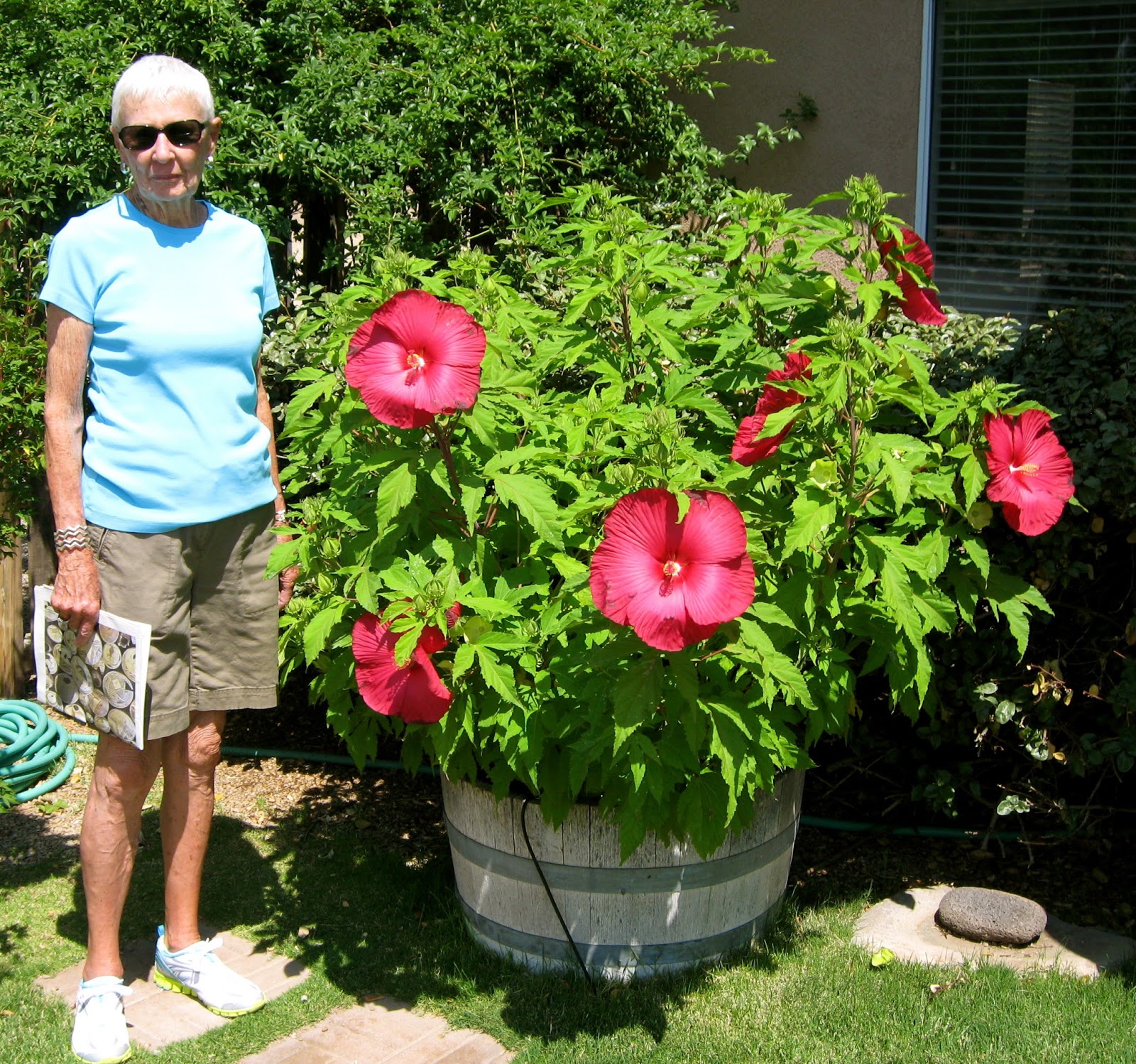
The other species of Hibiscus that we carry is Hibiscus moscheutos variety 'Luna Red'. Some common names are Rose Mallow and Dinner Plate Hibiscus and this is an herbaceous perennial meaning it will die to the ground in the winter and reemerge in spring. It grows to 2-3' tall and wide each season, its leaves are dark green with a whitish underside and the flowers that start in late June and continue until frost are no less than spectacular. Dark red, very tropical looking and at least 6" across. Our friend Lou has had one in a whiskey barrel for 3 years and it is a perfect specimen. It gets morning sun, afternoon shade and is protected from the west wind. So an east side would be ideal. She mulches it with straw each winter and it easily made it through the minus 8 we had a few years ago. All of these Hibiscus attract hummingbirds and butterflies.
Lou with her Hibiscus moscheutos 'Luna Red'

WE WILL BE CLOSED THURSDAY, JULY 4TH. ENJOY THE HOLIDAY
AND CELEBRATE YOUR INDEPENDENCE!